| |
| Course Offered - Department of
Electronics:- |
|
| |
|
The
Department of Electronics was established in July 2002-2003.
The Department of Electronics includes B.Sc. (Electronics).
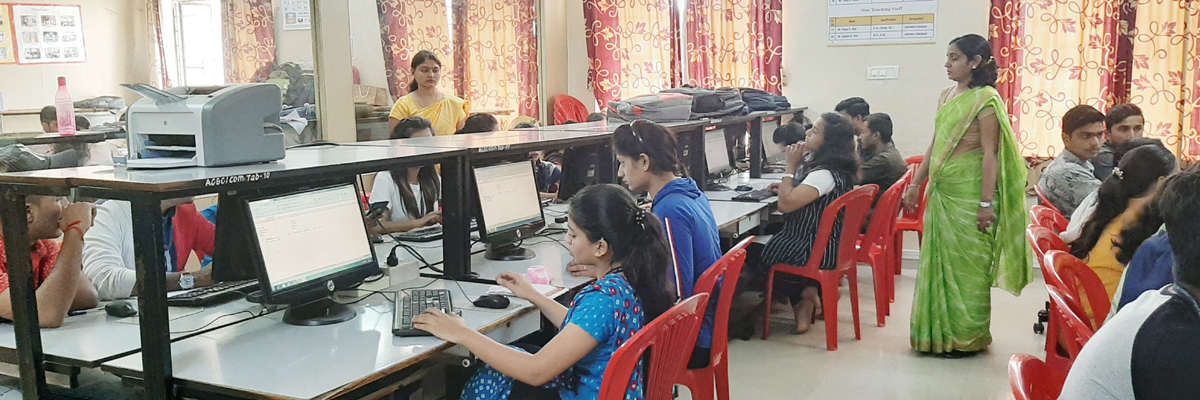
The department comprises adequately equipped laboratories.
Sufficient laboratory time is allocated to students for
optimal use of the computing facilities. Our primary
strength lies in our qualified, distinguished, and
experienced faculty members, who exhibit a strong enthusiasm
for acquiring new technologies and enhancing their skill
sets. Faculty members are always ready to guide students
beyond regular classroom hours and maintain a controlled
environment in the department. |
| |
|
Programmes:- |
| |
- B.Sc. Electronics (3
Years)
|
| Salient
Features:- |
| |
-
Well-equipped labs:
Well-equipped labs for Electronic Circuits,
Communication, Microprocessors, Digital Electronics,
Embedded Systems, Opto-electronics, and VLSI design.
-
Modern Software Tools: Use
of simulation and analysis tools such as MATLAB,
Proteus, and Xilinx Vivado for circuit design and
simulation.
-
Industry Collaboration:
Interaction with industry experts through workshops,
seminars, and guest lectures to align with market
trends.
-
Practical Training: Focus
on hands-on learning through mini-projects, in-plant
training, and technical competitions.
-
Well qualified and
dedicated staff.
|
Job Opportunities
1. Core Hardware & Semiconductor |
| |
- VLSI Design Engineer:
Designs and optimizes complex integrated circuits (ICs)
and microprocessors.
- PCB Design & Layout
Engineer: Creates schematics and printed circuit board
assemblies (PCBAs) for electronic devices.
- Microelectronic
Engineer: Focuses on the production and miniaturization
of semiconductor components.
|
| 2. Embedded Systems &
Automation |
| |
- Embedded Systems
Engineer: Develops low-level firmware and software for
microcontrollers (e.g., ARM, STM32) and hardware
devices.
- IoT (Internet of
Things) Engineer: Builds and integrates sensors,
communication protocols, and cloud connectivity to make
devices "smart".
- Robotics Engineer:
Programs and designs control systems, automation
frameworks, and robotic arms.
|
| 3. Telecommunications &
Networking |
| |
- RF (Radio Frequency)
Engineer: Manages and optimizes wireless, satellite, and
mobile communication network architectures.
- Network Engineer:
Ensures the integrity, security, and maintenance of data
transmission systems.
- Telecommunications
Engineer: Focuses on network planning and fiber-optic or
microwave data transmission infrastructure.
|
| 4. IT & Software |
| |
- AI/ML Edge Engineer:
Transitions hardware knowledge into software by
deploying artificial intelligence algorithms directly
onto electronic devices.
- Firmware/Software
Analyst: Tests, debugs, and optimizes the code that
bridges electronic hardware and operating systems.
- Software Engineer /
Software Developer
- Technical Assistant
|
| 5. Government & Defence
|
| |
- Defence
Scientist/Engineer: Works on radar systems, electronic
warfare, and aerospace electronics in public sector
units like DRDO or ISRO.
- Telecommunications
Officer: Manages national network and public utility
infrastructure.
|
| |
| |